
What Is a Reconstitution Solution and Why It Matters in Laboratory Research
Reconstitution Solution and its use in Laboratory
Scientists need accuracy and consistency that they cannot compromise during their current laboratory research activities. Scientists need exact methods for preparing their materials which include peptides and biological samples and powdered reagents in order to achieve trustworthy results. The laboratory process requires a reconstitution solution which serves as an essential element.
The reconstitution solution enables safe dissolution and dilution of powdered compounds while preserving their stability and purity. The selection of an appropriate laboratory reconstitution solution determines three essential research elements which include experimental accuracy and sample integrity and research results.
What Is a Reconstitution Solution?
A reconstitution solution is a specially formulated sterile liquid used to dissolve or dilute dry laboratory compounds. The system provides correct material preparation through designated concentration levels which it follows without allowing any outside elements to create contamination or material instability.
- Reconstitution solutions are commonly used for:
- Peptide and protein preparation
- Biological sample dilution
- Research reagents and powdered compounds
- Controlled laboratory experiments
Laboratory-grade reconstitution solutions differ from regular water because they undergo strict quality control procedures which guarantee their sterility and clarity and uniform properties.
Why Reconstitution Accuracy Is Critical in Labs
Experimental results become invalid when any reconstitution process shows even the slightest deviation from its expected outcome. Molecular behavior and reproducibility of results become affected when impurities or solvent use or unstable formulations exist.
The key dangers which arise from using solutions of low quality during laboratory work include:
- Sample degradation
- pH instability
- Contamination
- Inaccurate concentrations
This is why professional laboratories require sterile laboratory solutions which manufacturers produce for use in controlled research experiments.
The Role of Benzyl Alcohol in Reconstitution Solutions
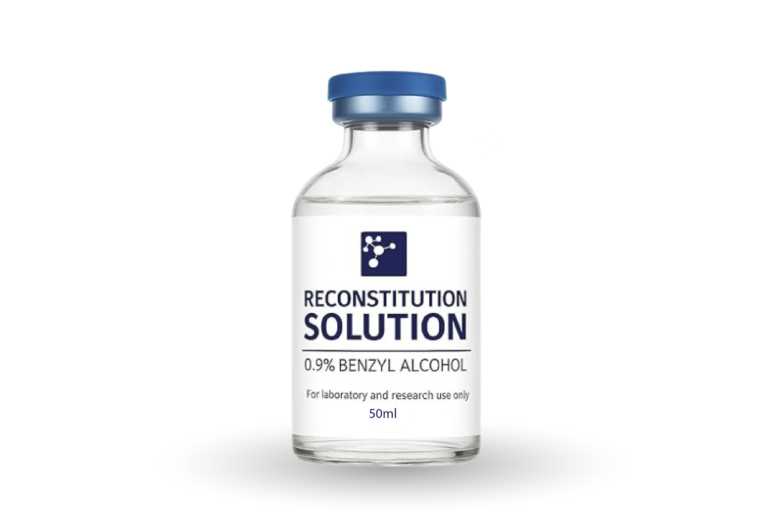
Laboratories use 0.9% Benzyl Alcohol as a standard ingredient in their reconstitution solutions because it functions as a stabilizing and preserving agent. When benzyl alcohol gets used according to proper formulation guidelines it improves solvent quality while maintaining the stability of delicate substances.
- The advantages of using 0.9% Benzyl Alcohol include:
- Improved solution stability
- Reduced microbial risk
- Compatibility with peptides and lab reagents
- Extended shelf integrity under proper storage
Pharmera Health creates its reconstitution solution through the precise combination of pharmaceutical-grade benzyl alcohol which guarantees consistent laboratory results.
Why Pharmera Health’s Reconstitution Solution Stands Out
Pharmera Health develops lab-use products with a strong focus on precision, sterility, and compliance. Each 50mL vial is professionally sealed, clearly labeled, and produced in a sterile laboratory environment.
The main benefits which this system provides for users include:
- High-purity formulation
- Crystal-clear, filtered liquid
- Secure USP/EP-compliant packaging
- Strict batch verification and quality checks
The standards which they established guarantee laboratories will maintain consistent performance during their work which requires precise measurement.
Conclusion
Laboratories require high-quality reconstitution solutions because these solutions serve as essential elements which enable scientists to conduct their research work. The complete research process requires careful examination of every aspect, which includes testing for stability and sterility and checking compliance and packaging.
Pharmera Health provides laboratory-grade reconstitution solutions which modern research facilities need to produce consistent and dependable results.