
Pharmera Health Reconstitution Solution: What Laboratory Buyers Should Know
When laboratories evaluate reconstitution solutions, the choice is not about finding a liquid that can dissolve a research compound. Buyers have to think about more than that. They need to look at how the solution is manufactured, whether it’s consistent from batch to batch, how it is packaged, what documentation comes with it, how it should be stored, what sizes are available, whether supply will be reliable, and whether the product’s intended use matches what their lab actually needs. That’s where supplier details become important.
Introduction
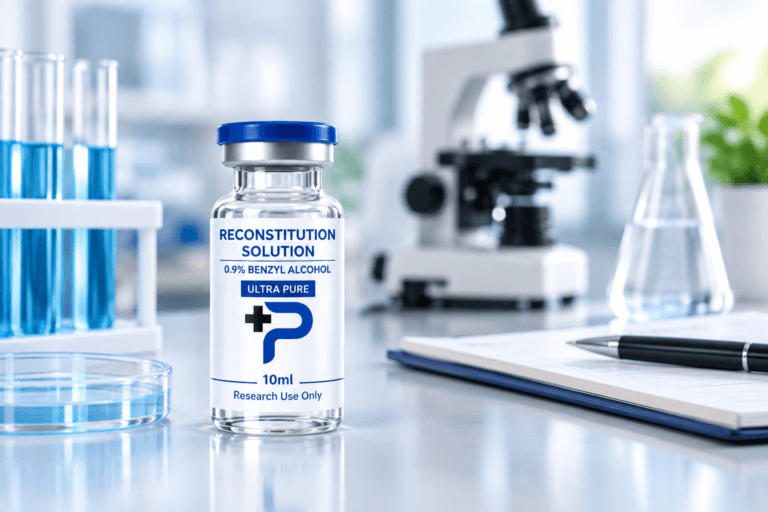
Pharmera Health offers reconstitution solutions made for laboratory research. Their focus is on formulation, batch quality control, packaging, and steady supply. On their website, they describe their reconstitution solution as a high-purity mix with 0.9% benzyl alcohol.
For laboratory buyers, the real question isn’t just “Which reconstitution solution should I buy?” It’s deeper than that. It’s: Does this product deliver the formulation, quality data, packaging, documentation, and supply options that my lab actually needs for the research I’m doing?
This guide will discuss what buyers should consider when looking at Pharmera Health’s reconstitution solution. It will help them know what to check before making a purchase.
What Is Pharmera Health Reconstitution Solution
Pharmera Health’s reconstitution solution is a high-purity product designed for laboratory research. The current product information lists a formulation that includes 0.9% benzyl alcohol and clearly states the product is for Research Use Only. This means it is not intended for animal use nor for general healthcare purposes.
Buyers who want to compare this type of product with another commonly discussed pharmaceutical water preparation can also review Reconstitution Solution vs Bacteriostatic Water to understand how the two differ in formulation, purpose, and application.
The company focuses on supplying reconstitution solutions and related products to laboratories. Its About Us page emphasizes quality control, consistent formulation, and reliable supply. This positioning is relevant to laboratory buyers because it highlights the importance of product quality, formulation consistency, and dependable supply for research applications.
For laboratory buyers, this distinction matters. Before choosing any product, including Pharmera Health’s reconstitution solution, the intended research application must be considered. A product may seem suitable based on its name or appearance. If it doesn’t meet the specific needs of the lab protocol, it could compromise results.
An answer for laboratory buyers: Pharmera Health’s reconstitution solution is a research-grade product. It comes in vial sizes, contains 0.9% benzyl alcohol, and undergoes batch quality checks. However, it is meant for laboratory research. Buyers should assess whether this product aligns with their work before purchasing.
What should laboratory buyers evaluate first?
They should begin with a checklist. This helps avoid focusing on price or convenience. Key items include:
- The research application
- The exact product formulation
- Purity levels and consistency data
- Available batch or quality documentation
- Container and seal integrity
- Vial size options
- Storage requirements
- Supplier’s ability to maintain supply continuity
- Order quantities available
- Level of supplier support
- Whether the product is labeled for research use only
These factors help ensure the solution fits both the lab’s immediate needs and long-term workflow. Even if two products look similar—vial size, same color, same label—their formulation details, documentation, packaging, and supply history can vary widely. For labs that buy frequently, these differences grow more significant over time. One small change in documentation or availability can affect project timelines and compliance.
By reviewing all these points, laboratory buyers make better decisions based on science, not just appearances.
Formulation Information Matters
One of the things a laboratory buyer should check is what is actually in the product. Current Pharmera Health product information identifies 0.9% benzyl alcohol as part of its reconstitution solution formulation. The company describes the ingredient in relation to its stabilizing properties. This information gives buyers a starting point for evaluating whether the formulation meets their research requirements. However, formulation information should not be interpreted as a compatibility statement.
A laboratory should still consider:
- The material being reconstituted
- The research protocol
- Required concentration
- Compatibility requirements
- Stability considerations
- Any restrictions associated with the research material
A solution being appropriate for one laboratory procedure does not automatically make it appropriate for every procedure. This is particularly important when research materials have formulation or stability requirements.
This is why buyers should look beyond the product name and examine the formulation itself. For additional context, see What Is in Bacteriostatic Water? Ingredients Explained, which provides a related example of how formulation details can distinguish one laboratory or pharmaceutical water preparation from another.
Why 0.9% Benzyl Alcohol Is Relevant to Buyers
For buyers comparing laboratory solutions, the preservative component is a formulation detail to review. Benzyl alcohol can serve as a preservative in formulations. Its presence should not be confused with sterilization or treated as a guarantee that improper handling cannot affect product quality. This distinction is especially important when comparing laboratory solutions.
A buyer should check the formulation information provided for the product rather than assuming that all reconstitution solutions have the same composition. If a laboratory has a protocol that specifies formulation characteristics, those requirements should be checked against the product information before purchase.
Buyers who want to understand the broader role of preservatives can also review Does Bacteriostatic Water Contain Preservatives? Important Facts for additional background on preservative-containing formulations.
Quality Control Is an Important Purchasing Factor
For recurring laboratory purchases, consistency matters as much as the original product specification.
Pharmera Health says its batches go through verification checks. These checks include fill level, seal quality, and label precision. The company’s website also outlines how it manages batch quality control and formulation consistency. These checks are important because a laboratory product is not judged by the liquid inside the vial.
The complete product includes:
- Formulation
- Container
- Closure
- Labeling
- Batch information
- Documentation
A buyer looking at a supplier can ask these questions:
- Is the formulation clearly identified?
- Is the vial properly sealed?
- Is the labeling readable and complete?
- Is batch information available?
- Can quality documentation be obtained?
- Are product specifications clearly presented?
These questions build a purchasing framework rather than just comparing prices.
Certificate of Analysis and Batch Documentation
Laboratory buyers may also want documentation to support their evaluation. Pharmera Health says its Certificate of Analysis (COA) is updated whenever a new batch is made or received.
A COA can be helpful because laboratory buyers often need batch details when checking incoming materials or keeping their own records.
Buyers should keep in mind the difference between:
- A general product description
- A product specification
- Batch-specific quality documentation
- Laboratory-specific acceptance requirements
Suppliers’ documentation should be reviewed based on the buyer’s own quality system.
For organizations with purchasing or quality-control processes, documentation requirements are often set before placing an order.
This makes the purchasing process smoother. The laboratory knows what information it needs before reviewing suppliers.
Packaging Is Part of the Product
Laboratory buyers sometimes focus on how the product is made and overlook the packaging.
That can be a mistake.
The vial is part of the product system because it holds the solution in a container during transport, keeping it safe, and when it is used in the lab.
The current Pharmera Health product information says its reconstitution solution comes in sealed glass vials. The website also discusses vial closure and packaging that help keep the product safe.
When looking at packaging, buyers should check:
- Vial material
- Fill volume
- Closure system
- Seal condition
- Label readability
- Protection during shipping
- Packaging quantity
A laboratory buying an amount for occasional research might need different packaging than an organization that keeps a regular stock.
Packaging Is Part of the Product
Storage is another real-world factor that should be part of the buying decision.
Pharmera Health says the solution should be stored at room temperature away from heat and direct light, and the vial should be kept closed when not in use. Lab buyers should check the product instructions and labels to find the storage rules for the product they get.
This is especially important for people who are buying a large number of units.
Before buying in bulk, buyers can think about:
- How much space is available for storage
- What the temperature is like
- If the product is exposed to light
- How the inventory is turned over
- What condition the containers are in
- When the product expires
Good planning helps avoid wasting product.
What Does Research Use Mean?
A key point for buyers is what the product is meant for.
Pharmera Health says its reconstitution solution is for Research Use Only.
This means laboratory buyers need to consider the product the way the supplier presents it. Research products should not be viewed as medicines, medical items, or substitutes for products intended to be given to people.
Because of this, buyers should be clear about the difference:
Lab research use is not the same as medical use. The product description and labels should be read before buying, especially if the organization works with both research items and products.
Is Pharmera Health Suitable for Laboratory Research Purchasing?
Pharmera Health says it was built for lab research. Their site mentions they work with labs, research groups, scientific schools, distributors, wholesale buyers, private-label brands, and OEM manufacturers. That means if you’re in a lab, you can check them out not just for one small vial, but also for regular ongoing orders.
If you’re thinking about buying from Pharmera Health, here’s what you can check:
Product formulation. Does the formula listed fit what you need for your research?
Product size. Do they offer vials that match your lab’s sizes?
Documentation. Do they give you the quality papers your lab requires?
Packaging. Do the bottle and cap meet your lab’s standards?
Supply. Can they keep up with how much you plan to buy?
Research-use status. Does the product say it’s for research only?
Support. Can they help you before you buy and after?
This way you’re not just trusting ads. You’re checking facts.
Wholesale, Private Label and OEM Supply
Not every laboratory buys one vial at a time. Some need batches or regular deliveries.
Pharmera Health says they can handle orders, private-label brands, and OEM production for groups that want more or customized products.
This could be useful for:
- Research groups
- Lab supply companies
- Distributors
- Private-label brands
- Any group that needs the product again and again
If you’re planning a big buying plan, you might want to talk with them about:
- How many you expect to order
- What form the product should be in
- What kind of packaging you need
- How labels should look
- How production will work
- What documents you need
- When deliveries should come
This is not like buying from a store. It’s more serious. You should talk to them directly.
Pharmera Health Reconstitution Solution: Buyer Checklist
Before purchasing, laboratory buyers can use this checklist:
What to check |
Why it matters |
|---|---|
Formulation
|
Confirms the product characteristics
|
0.9% Benzyl Alcohol
|
Identifies the listed preservative component
|
Intended use
|
Confirms research-use positioning
|
Vial size
|
Helps match product quantity to laboratory needs
|
Packaging
|
Supports evaluation of container integrity
|
Batch information
|
Helps with product traceability
|
COA availability
|
Provides additional quality documentation
|
Storage information
|
Supports proper inventory management
|
Supplier capacity
|
Important for recurring purchases
|
Purchasing options
|
Helps match individual, multi-pack, or larger-volume needs
|
This checklist can also be used when comparing Pharmera Health with other laboratory solution suppliers.
Common Buying Mistakes to Avoid
Laboratory buyers can make purchasing decisions efficiently by avoiding several common mistakes.
Choosing Based on Price
A lower listed price does not necessarily provide enough information about formulation, documentation, packaging, or supply.
Ignoring the Intended Use
A research product should be evaluated according to its purpose. Buyers should not assume that a laboratory solution is automatically suitable for therapeutic applications.
Not Checking the Formulation
The presence or absence of a preservative can matter for compatibility and research protocols.
Buying More Than the Laboratory Can Properly Store
Bulk purchasing can be useful. Only when the quantity makes sense for the laboratory’s storage and usage requirements.
Skipping Documentation Review
If a laboratory requires batch documentation or quality records, these requirements should be confirmed before purchasing.
What Makes a Supplier Worth Evaluating?
There is no single factor that determines whether a laboratory supplier meets every buyer’s needs. Instead, buyers should look for product information and a purchasing process that allows them to verify details for their specific application.
For a laboratory solution supplier, useful information includes:
- Clear formulation details
- Product size
- Intended-use information
- Packaging description
- Storage instructions
- Quality-control information
- Batch documentation
- Purchasing options
- Supplier contact information
Pharmera Health’s product and company information addresses these areas through its product listings, quality information, research-use positioning, and supply options.
That gives laboratory buyers information they can review before deciding whether the product fits their purchasing requirements.
Final Considerations for Laboratory Buyers
I believe choosing a laboratory reconstitution solution is ultimately a product evaluation and purchase decision. It is not simply about finding the price or the most familiar product name. Laboratory buyers should review the formulation, intended use, quality information, documentation, packaging, storage requirements, size, and supply options before placing an order.
Pharmera Health positions its reconstitution solution for laboratory research applications. It provides product information covering formulation, vial sizes, quality‑control checks, documentation, and purchasing options.
For laboratories considering Pharmera Health, I suggest the next step is to review the product information.
Determine whether the formulation and available purchasing configuration match the laboratory’s requirements.
If the laboratory has recurring or larger‑volume needs, Pharmera Health also provides multi‑pack, wholesale, private‑label, and OEM options.
These can be discussed directly with the supplier.
For product specifications, available sizes, pricing, and purchasing information, visit Pharmera Health’s reconstitution solution collection.
What People Ask?
1.What is Pharmera Health reconstitution solution used for?
Pharmera Health presents its reconstitution solution for laboratory research applications. The product should be evaluated against the laboratory protocol and intended research use.
2.What formulation does Pharmera Health reconstitution solution contain?
Current Pharmera Health product information identifies 0.9% benzyl alcohol in the formulation. Buyers should review the product labeling and documentation for the exact product purchased.
3.What sizes are available?
Current product information lists 10 mL and 30 mL options, with individual and multi-pack configurations available.
4. Is the product intended for use?
Pharmera Health identifies the reconstitution solution as Research Use Only. It should therefore be used according to its stated research purpose and applicable product information.
5.Does Pharmera Health provide quality documentation?
The company states that its COA information is updated with each batch produced or received. Buyers with documentation requirements should confirm the available records for the product and batch they intend to purchase.
6. Does Pharmera Health offer purchasing options?
Yes. Pharmera Health describes supply, as well as multi-pack and bundle options. Its company information also identifies label and OEM manufacturing support.
7. How should the product be stored?
Current Pharmera Health information recommends room-temperature storage away from heat and direct light, with the vial kept tightly sealed when not in use. Buyers should follow the product labeling and instructions supplied with their order.
8. How often do you update the Certificate of Analysis (COA) for your products?
The choice should reflect the laboratory’s expected research requirements, handling practices, storage capacity, and purchasing frequency. Pharmera Health currently lists both 10 mL and 30 mL options.
